
The rise of consumer wearables from smartwatches to continuous glucose monitors has generated a massive influx of patient-generated health data (PGHD). In fact, by 2024, an estimated 107 million U.S.
adults were using wearable devices, and 78 million were actively willing to share this data with their healthcare providers. While patients are increasingly eager to share these insights, many US physicians feel overwhelmed by the sheer volume of unstructured information and the lack of clear clinical context. Successful wearable health tech integration means moving beyond data fatigue and establishing highly efficient workflows. By understanding device limitations and leveraging the right digital tools, clinics can turn raw numbers into actionable insights. This comprehensive guide explores what modern practices must know to successfully integrate wearable technology, improve patient outcomes, and avoid provider burnout.
Contents
- Why Is Wearable Health Tech Integration Essential Today?
- When Should Physicians Actually Rely on Patient-Generated Data?
- How Can Clinics Successfully Integrate Wearable Data into EHR Workflows?
- Why Do Liability and Privacy Concerns Still Stall Adoption?
- How to Turn Raw Wearable Data into Actionable Patient Outcomes
- The Future of Wearable Health Tech in US Clinics
Why Is Wearable Health Tech Integration Essential Today?
Modern healthcare is undergoing a massive shift. The traditional model of reactive care where a patient only visits the clinic when they feel sick is rapidly being replaced by proactive, continuous monitoring. Wearable health tech integration is the driving force behind this transformation.
For physicians, these devices serve as a vital bridge between infrequent clinic visits. A patient might only spend 15 minutes in an exam room a few times a year, leaving massive gaps in their clinical history. Wearables fill these gaps by capturing episodic events. For example, a smartwatch might record instances of paroxysmal atrial fibrillation (Afib) that a standard in-clinic ECG or even a short-term Holter monitor completely misses.
Furthermore, patient expectations are evolving. When consumers invest in fitness trackers or smart rings, they expect their primary care providers to care about the data they generate. Integrating this information into your practice isn’t just about adopting new technology; it’s about meeting your patients where they are. As Dr. John Whyte, MD, MPH, CEO of the American Medical Association (AMA), noted in a 2026 report, “We have all this data that’s available, but it’s actually not actionable because we don’t have a way to get it into clinical workflow.”
In fact, embracing these innovations and resolving this workflow gap aligns perfectly with modern healthcare marketing trends, as clinics that offer tech-forward, personalized care naturally attract and retain more highly engaged patients.
When Should Physicians Actually Rely on Patient-Generated Data?
One of the biggest challenges for physicians is distinguishing the signal from the noise. Not all data is created equal, and knowing when to act on wearable data is just as important as knowing how to collect it.
Physicians must learn to differentiate between general wellness trends and true clinical signals. Daily step counts, estimated caloric burn, and general sleep duration are excellent wellness indicators. They help establish a patient’s baseline lifestyle and can be great motivational tools for weight loss or physical therapy. However, they are not strictly diagnostic.
On the other hand, clinical signals such as recurrent drops in blood oxygen saturation (SpO2) during sleep or sudden, sustained tachycardic events while resting require a different level of attention. According to experts in cardiology and primary care, the true value of wearable data lies in long-term trends rather than isolated, anomalous readings. A single spike in heart rate might just be stress or a faulty sensor reading, but a steadily increasing resting heart rate over three months warrants a thorough clinical investigation.
The Accuracy Debate: Can Doctors Trust the Numbers?
If you are going to make clinical decisions based on consumer devices, you need to know which numbers to trust. The medical community has heavily debated wearable device validation, and the consensus is that reliability varies drastically depending on what is being measured.
| Metric Measured | Clinical Reliability | Margin of Error / Variability | Best Clinical Use Case |
| Resting Heart Rate (ECG) | High (FDA cleared on many) | ±2–5 bpm | Afib detection, general baseline health |
| Step Count / Activity | Moderate-High | ±3–10% variance | Post-op recovery, lifestyle changes |
| Sleep Architecture | Low-Moderate | ±10-20 mins | Identifying gross sleep deprivation |
| Cuffless Blood Pressure | Low (Highly experimental) | Wide variability | Not recommended for diagnostic use |
- Resting Heart Rate and ECGs: These are highly reliable. Many modern smartwatches have received FDA clearance for their ECG features, specifically for detecting signs of atrial fibrillation. The optical heart rate sensors used to track resting heart rate are generally accurate and can be trusted to establish a solid baseline.
- Step Counts and Activity Levels: These sensors are good for general baselines. While they might have a margin of error of ±3–10%, they are accurate enough to tell you if a patient is predominantly sedentary or active.
- Blood Pressure (Cuffless) and Sleep Architecture: Exercise extreme clinical caution here. Cuffless blood pressure monitoring via smartwatches is still largely experimental and shows wide variability. Similarly, while wearables can track how long a patient was immobile in bed, their ability to accurately map complex sleep stages (REM vs. deep sleep) without EEG data is highly limited.
How Can Clinics Successfully Integrate Wearable Data into EHR Workflows?
The American Medical Association (AMA) has repeatedly highlighted interoperability as the biggest barrier to wearable health tech integration. In their 2026 Multi-Country Study on Consumer Wearable Data in Clinical Practice, the AMA found that while 97% of physicians review wearable data and 77% believe it offers a clinical advantage, only 6% have successfully integrated it into their workflows.
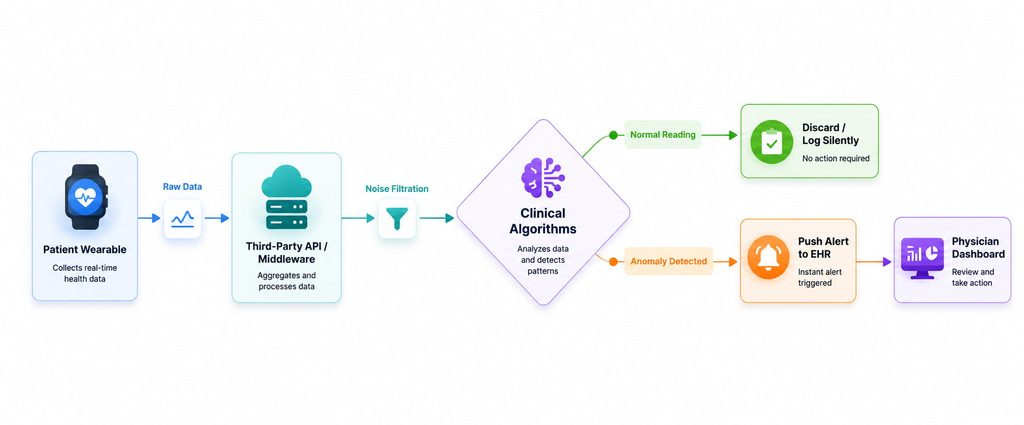
How do we solve this? The answer lies in smart workflow design. Here is a look at a successful data integration pipeline:
The absolute worst-case scenario for a physician is the “data dump”—a patient bringing in a printed spreadsheet of 10,000 heart rate readings or trying to hand over their phone during a 15-minute consultation. This leads directly to data overload and physician burnout.
To successfully integrate this data, clinics must use middleware or specific integration platforms. Tools like Apple HealthKit for Clinics, or third-party API aggregators, can pull data from patient devices, filter out the noise, and push only the clinically relevant alerts directly into your Electronic Health Records (EHR) system. The goal is to view summarized dashboards and exception alerts, not raw minute-by-minute logs.
Setting Boundaries to Prevent Data Overload
Technology is only half the battle; the other half is communication. Clinics must establish clear data-sharing agreements with their patients. During the onboarding process for Remote Patient Monitoring (RPM), tell patients exactly what you will monitor and when.
For example, a physician might explain: “We will review your continuous glucose monitor trends every Friday afternoon. We are not monitoring your heart rate 24/7.” Setting these boundaries prevents patients from expecting immediate responses to every minor fluctuation in their watch records, thereby protecting the provider’s time and mental bandwidth.
Wearable health tech integration shouldn’t just be a clinical upgrade; it should also be a financially sustainable practice model. Integrating patient-generated health data can be financially viable through Remote Patient Monitoring (RPM) CPT codes.
When implemented correctly, RPM turns what used to be uncompensated data-review time into a structured revenue stream. Key CPT codes include:
- CPT 99453: Covers the initial setup and patient education on using the monitoring device.
- CPT 99454: Covers the monthly supply of the device and the daily recording or programmed alert transmissions.
- CPT 99457 (and 99458): Covers the clinical staff time (at least 20 minutes per month) spent communicating with the patient and managing their care based on the data received.
By utilizing these codes, clinics can justify the time spent reviewing wearable data, ensuring that technological adoption supports the financial health of the practice.
Why Do Liability and Privacy Concerns Still Stall Adoption?
Despite the clear benefits, many US physicians hesitate to adopt wearable technology due to looming legal and ethical concerns. The primary fear is liability: If a patient’s wearable device flags a dangerous arrhythmia at 2:00 AM on a Sunday, and the doctor doesn’t see the alert until 9:00 AM on Monday, who is liable if an adverse event occurs in the interim?
To mitigate this risk, clinics must establish clear Service Level Agreements (SLAs) with their patients. It must be documented and explicitly communicated that wearable monitoring is for chronic care management and trend analysis, not an emergency response system. Patients must understand that if they experience acute symptoms like chest pain or severe shortness of breath, they must call 911, regardless of what their device says.
Privacy is another massive hurdle. Consumer apps are notoriously relaxed with user data, often selling it to third-party advertisers. Physicians must ensure that any middleware or integration platform they use to port data from a consumer device into the EHR is strictly HIPAA compliant. Vetting the software vendors that handle this data transition is a non-negotiable step in the integration process.
How to Turn Raw Wearable Data into Actionable Patient Outcomes
Having access to data is useless if it doesn’t lead to better patient care. The goal of wearable health tech integration is to turn raw data into actionable clinical outcomes.
When a patient brings in their wearable data, physicians should focus on the delta the change over time. If a patient with hypertension shows a gradual reduction in their resting heart rate and an increase in daily step counts over six months, the data serves as positive reinforcement. The physician can use this tangible evidence to celebrate the patient’s adherence to lifestyle modifications, reinforcing good habits.
Empowering Patients Without Causing Health Anxiety
A negative side effect of the wearable boom is “cyberchondria” when patients fixate minor, normal bodily fluctuations and assume the worst. A smartwatch alerting a user to an elevated heart rate during a stressful meeting can cause a panic attack, which in turn raises the heart rate further, creating a vicious cycle.
Doctors must play a crucial role in contextualizing this data. One highly effective method is pairing wearable data with structured symptom checkers. If a patient device flags an irregular reading, physicians can instruct them to use a digital symptom questionnaire before rushing to the ER or booking an urgent appointment.
By asking questions like, “Your watch noted a heart rate spike where you were exercising, highly stressed, or did you also feel dizzy and short of breath?”, doctors can filter out benign events from true medical needs. This empowers the patient to understand their own body better without generating unnecessary clinical panic.
The Future of Wearable Health Tech in US Clinics
Looking ahead, wearable health tech integration is only going to become more seamless. Over the next few years, we will see a dramatic increase in the use of machine learning algorithms capable of filtering out motion artifacts and personalizing baseline readings for individual patients. Multi-sensor integration where devices cross-reference heart rate, skin temperature, and motion will vastly improve clinical accuracy and reduce false positives.
Furthermore, as the FDA continues to refine its software-as-a-medical-device (SaMD) pathways, we can expect a wider array of consumer wearables to achieve clinical-grade clearance.
Wearable health tech integration is no longer a futuristic concept; it is a current clinical reality that modern practices must embrace. By starting small, validating the devices you choose to monitor, setting clear boundaries with patients, and leveraging the right EHR integration tools, your clinic can stay ahead of the curve. The data is already out there it’s time for US physicians to harness it to drive better, more proactive patient care.