
Summary:
Independent clinics and small healthcare practices that go digital see faster patient growth, fewer missed appointments, and lower administrative overhead. This guide breaks down exactly how a focused healthcare digital transformation strategy built around a custom mobile app helps small and mid-size practices improve patient outcomes, stay competitive, and finally get their time back.
While modern consumers manage their entire lives from a smartphone, patients are still forced to navigate disjointed phone calls, paper clipboards, and outdated web portals. Independent practices and small healthcare groups are often the ones feeling this gap most acutely caught between rising patient expectations and limited internal resources.
To close that gap, growing healthcare practices must execute a focused healthcare digital transformation strategy that goes beyond a basic patient portal. By placing a custom, centralized mobile application at the core of your practice operations, you can connect your existing systems with modern patient expectations without needing an enterprise IT department to pull it off.
Contents
- Why is a Healthcare Digital Transformation Strategy Essential Today?
- When Should Independent Practices Start Their Mobile App Strategy?
- How to Implement a Scalable Healthcare Digitization Framework
- Core Features of a Winning Healthcare Practice Mobile App
- Overcoming the Challenges of Digital Transformation in Healthcare
- Conclusion: Partnering for Digital Success
Why is a Healthcare Digital Transformation Strategy Essential Today?
If you look closely at the landscape of American healthcare, the pressures mounting on independent practices are real and growing. It isn’t just about having the latest technology; it’s about staying competitive, retaining patients, and running a leaner, more efficient clinic. Here is why prioritizing a robust digital strategy is non-negotiable for SMB healthcare providers.
The Shift to Value-Based Care
The traditional fee-for-service model is rapidly being replaced by value-based care, which rewards healthcare providers for patient outcomes rather than the volume of services rendered. Digital transformation makes value-based care achievable even for smaller practices. By utilizing digital tools, independent providers can track patient health between visits, reduce costly no-shows and ER redirections, and proactively manage chronic conditions. Seamless digital integration ensures that a patient’s health trajectory is monitored continuously something patients increasingly expect from their care team.
Promoting Health Equity and Expanding Access
Digital tools break down geographical and socioeconomic barriers. Telemedicine, remote patient monitoring, and mobile health apps provide access to care for patients who struggle to make it to a physical clinic whether due to distance, mobility, or schedule constraints. For small practices, this is also a growth opportunity: offering virtual care expands your reachable patient population without requiring a new physical location. Digital transformation directly supports health equity, a priority for any practice committed to comprehensive, community-centered care.
The Financial Imperative
According to the Peterson Foundation, the U.S. spends over $4.5 trillion annually on healthcare yet a significant portion of that cost is driven by administrative inefficiency and reactive care, problems that hit small practices the hardest. When a front desk team of two is fielding 80 calls a day for scheduling and billing questions, the practice loses both revenue and clinician focus.
Digital transformation is the most practical way for independent providers to drive cost-efficiency at scale. By automating routine administrative tasks and enabling proactive patient engagement, practices can significantly reduce overhead without adding headcount.
According to HIMSS, practices that invest in digital patient engagement tools report measurably higher retention rates and improved care plan adherence. To turn that potential into reality, small and mid-size practices need tailored healthcare solutions that translate innovation into tangible patient experiences not enterprise software stacks.
When Should Independent Practices Start Their Mobile App Strategy?
The short answer? Immediately.
Delaying digital transformation leads to what IT consultants call “vendor sprawl”—a scenario where a practice buys several disconnected software tools that don’t communicate with one another, creating billing headaches, duplicate data entry, and frustrated staff. For small practices without a dedicated IT team, this compounds quickly.
You should critically evaluate your current digital posture and initiate a mobile app strategy if you notice any of the following trigger points:
- Low Patient Portal Engagement: If your web-based patient portal sees a login rate of less than 15%, it’s failing to engage your demographic.
- Disconnected Telehealth: If your telehealth platform is siloed from your primary EHR, forcing clinicians into double data entry.
- Administrative Bottlenecks: If your front desk staff spends more time answering billing and scheduling calls than interacting with patients in the clinic.
The Great IT Investment Shift
Historically, even small practices have poured disproportionate budget into maintaining legacy systems—outdated phone scheduling, manual billing workflows, paper-based intake forms. It is time to shift that investment toward patient-facing tools that actually drive revenue and loyalty. Leading healthcare analysts recommend redirecting even a modest portion of your technology budget toward consumer-facing digital tools as the highest-ROI move a growing practice can make.
Table: Traditional vs. Digital-First Healthcare IT Investment
| Investment Category | Traditional Hospital IT Model | Digital-First Hospital Model |
|---|---|---|
| Systems of Record (EHR, Billing) | 90% of IT Budget | 65% of IT Budget |
| Systems of Differentiation (Custom Workflows) | 8% of IT Budget | 20% of IT Budget |
| Systems of Innovation (Mobile Apps, AI, Wearables) | 2% of IT Budget | 15% of IT Budget |
By restructuring investments, your practice can fund the mobile app solutions that actually drive patient loyalty and operational ROI.
How to Implement a Scalable Healthcare Digitization Framework
Knowing you need a digital transformation strategy is one thing; executing it is another. For independent practice owners and clinic managers, rolling out a scalable framework requires a methodical approach that balances clinical safety with a better patient experience—without disrupting the workflows your team depends on day to day.
1. Formally Define “Digital” for Your Organization
Digital transformation means different things to different people in your practice. To your front desk, it means no more phone tag; to your clinical staff, it means less paperwork and faster documentation; to you as the practice owner, it means better revenue visibility and patient retention. Before writing a single line of code, align your team on a shared definition. In the context of the patient experience, “digital” must mean an intuitive, self-service capability that makes it easier for patients to connect with your practice—and easier for your staff to serve them.
2. Divide Technology into Agile Portfolios
Stop viewing IT as one massive monolith. Separate your foundational infrastructure (like your cloud storage and EHR) from your engagement layers (the Mobile App UI). This allows your engagement layer to iterate and improve rapidly without risking the stability of your secure medical records.
3. Map the Mobile Patient Journey
A successful mobile app strategy anticipates the patient’s needs at every stage of their healthcare journey:
- Pre-Care: Intuitive symptom checkers, doctor discovery, and frictionless appointment booking.
- Point-of-Care: Digital check-ins, real-time status updates during the visit, and immediate access to after-visit summaries.
- Post-Care: Remote monitoring syncs, secure messaging for follow-up questions, and easy-to-understand mobile bill pay.
4. Develop an API and Data Operating System
An app is only as good as the data feeding it. Your mobile application must communicate bi-directionally with your existing EHR system whether that’s Athenahealth, DrChrono, Jane App, or a larger platform like Epic or Cerner. Developing a robust API layer ensures that when a patient updates their allergy list or completes intake forms in the app, your clinical staff sees it immediately no double entry, no chasing paperwork.
5. Strategically Select Vendor Partners
A common mistake independent practices make is buying an “off-the-shelf” white-labeled app. These generic SaaS products inevitably fall short because every practice’s workflow is unique and a one-size-fits-all tool rarely fits anyone well. To succeed, you must partner with specialized app development agencies that understand the nuances of HIPAA compliance, medical data security, and bespoke architecture.
Core Features of a Winning Healthcare Practice Mobile App
When you transition from high-level strategy to tangible product development, what features actually move the needle? A winning healthcare app acts as a digital front door, combining several complex technologies into one seamless interface.
AI-Driven Triage and Chatbots
Artificial intelligence is transforming how patients connect with their care team before they even walk through the door. By integrating smart intake chatbots, patients can describe their symptoms and receive immediate guidance on whether to book a routine visit, visit an urgent care clinic, or seek emergency care. This not only improves patient confidence but significantly reduces the volume of inbound triage calls fielded by your front desk staff. Leveraging modern AI development ensures these bots learn and improve over time.
Integrated Telemedicine
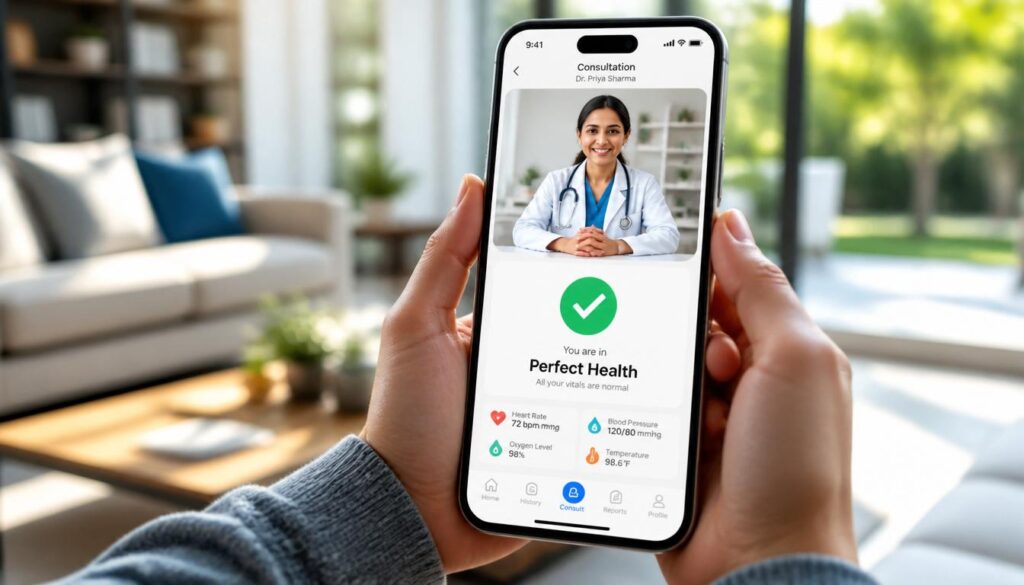
Telehealth shouldn’t require patients to download a separate, third-party video conferencing tool. A well-built practice app integrates secure, native video consultations directly within the same platform your patients already use for scheduling and messaging. During the call, providers can document notes that sync directly to the EHR, and patients can reference their recent lab results on the same screen—all without switching apps.
Wearable Device Integration (IoT)
The Internet of Things (IoT) has made real-time health monitoring accessible beyond hospital walls. By allowing your practice’s mobile app to sync with Apple Health, Google Fit, or specialized medical wearables (like continuous glucose monitors or smart blood pressure cuffs), your providers can transition from reactive treatments to proactive, preventative care—a model that improves outcomes and differentiates your practice from competitors still relying on quarterly check-ins alone.
Frictionless Revenue Cycle Management
Medical billing is notoriously confusing for patients—and chasing payments is one of the biggest time drains for small practices. A well-designed mobile app simplifies this by offering transparent, in-app mobile billing. Patients can verify their insurance eligibility, review their explanation of benefits in plain language, and set up payment plans with a few taps—significantly reducing your outstanding balances and the staff time spent on collection calls.
Overcoming the Challenges of Digital Transformation in Healthcare
While the benefits are immense, the road to digital maturity is fraught with hurdles. Acknowledging these challenges early in your strategy formulation is the key to bypassing them.
Data Privacy, Security, and Compliance
The single biggest concern in healthcare tech is cybersecurity. Between 2009 and 2022, over 5,000 healthcare data breaches occurred, exposing millions of records. Your mobile app strategy must treat security as the foundational bedrock, not an afterthought. This means implementing end-to-end encryption, multi-factor authentication (MFA), and rigorous HIPAA-compliant cloud environments.
Resistance to Change and Adoption Gaps
Technology is useless if no one uses it. You will face resistance from two fronts: older demographics who may find the tech intimidating, and busy clinicians who suffer from “new software fatigue.”
- For Patients: Focus heavily on UI/UX design. Utilize large fonts, high-contrast modes, and intuitive navigation.
- For Clinicians: The app must seamlessly integrate into their existing workflow. If a new app adds five extra clicks to a doctor’s day, they will abandon it.
The Interoperability Hurdle
Small practices often operate with disconnected tools—a scheduling platform that doesn’t talk to the billing system, a telehealth tool that doesn’t sync with the EHR, and a patient portal that nobody logs into. Breaking down these data silos so that every function speaks to the same centralized mobile backend requires a thoughtful integration strategy but the payoff in staff efficiency and patient experience is significant. For a deeper look into aligning your digital and growth goals, explore these digital marketing strategies for healthcare.
Conclusion: Partnering for Digital Success
The digital transformation of independent healthcare practices is no longer a distant priority it is an immediate competitive necessity. Patients today compare their healthcare experience to every other digital interaction in their lives. If booking an appointment at your practice is harder than ordering a rideshare, you are already losing patients to providers who have made the switch.
Moving away from fragmented, manual workflows and placing a unified mobile experience at the center of your practice is how you grow sustainably in 2026 and beyond. However, building a secure, patient-centric digital ecosystem requires expertise that most independent practice teams simply do not have the bandwidth to manage internally. That is where a committed technology partner makes all the difference.
At Simple Solutionz, we partner exclusively with independent healthcare providers and small-to-mid-size practices ready to build a digital experience their patients will actually use. From HIPAA-compliant architecture to patient-centric mobile design, our team brings healthcare technology expertise without the enterprise price tag. And because we believe in outcomes over invoices, we offer a complimentary Digital Readiness Audit for qualifying practices—a no-commitment assessment that maps your current gaps, identifies your top three digitization opportunities, and delivers a prioritized 90-day roadmap.
If our roadmap does not show a clear path to measurable ROI, we will tell you. For practices ready to move further, we structure our engagements around milestones not hours. You pay when we deliver results: discovery complete, architecture approved, first feature live, full deployment done. No surprise invoices, no open-ended retainers.
We are also open to exploring gain-share arrangements for the right partners where a portion of our fees is tied directly to the outcomes we generate together, whether that is reduced no-show rates, lower front-desk call volume, or faster billing cycles. If the results do not materialize, neither does our full fee.
Ready to see what a digital-first practice could look like for you? View our healthcare solutions to see how we have helped independent practices grow, or contact us today to claim your free Digital Readiness Audit. Your patients are ready for a better experience let’s build it together.